Table of Contents
Introduction
Many students believe that building wealth can only begin after landing a high-paying job. However, that is one of the biggest financial myths. In reality, the habits you develop during your student years have a much greater impact on your future wealth than your starting salary.
You don’t need to earn lakhs every month to become financially successful. What you need is discipline, patience, and a clear financial plan. Even if you receive a monthly allowance or earn a small amount through freelancing or a part-time job, you can start building a strong financial foundation today.
The biggest advantage you have in your 20s isn’t money—it’s time. Thanks to the power of compounding, small investments made consistently over many years can grow into significant wealth.
In this guide, you’ll learn practical and beginner-friendly steps to build wealth as a student in India. These strategies don’t require a large income, only smart financial decisions and consistency.

1. Understand Why Starting Early Matters
One of the greatest advantages young people have is time. Money invested early has decades to grow.
Imagine two friends:
- Rahul starts investing ₹1,000 every month at age 20.
- Aman waits until age 30 to invest the same amount.
Although Aman may earn a higher salary later, Rahul’s investments have an extra ten years to compound. Over the long term, Rahul is likely to accumulate much more wealth simply because he started earlier.
This is known as compound growth, where your investment earns returns, and those returns begin earning returns as well.
Why Time Is More Valuable Than Money
Many people delay investing because they think:
- “I’ll start after getting a job.”
- “I don’t earn enough.”
- “I’ll invest when I have more savings.”
Unfortunately, waiting is often the most expensive financial mistake.
Even investing a small amount regularly can create a significant difference over 20–30 years.
Key Takeaway
Don’t wait to become rich before investing.
Invest first, and let time help you become wealthy.
2. Set Clear Financial Goals
Building wealth without goals is like traveling without a destination.
Financial goals help you stay motivated and make better decisions with your money.
As a student, your goals might include:
Short-Term Goals (Within One Year)
- Buy a laptop
- Build an emergency fund
- Pay for an online course
- Purchase study materials
Medium-Term Goals (1–5 Years)
- Higher education
- Professional certifications
- Starting a small business
- Buying your first vehicle
Long-Term Goals (10+ Years)
- Financial independence
- Buying a home
- Early retirement
- Building a large investment portfolio
Make Your Goals SMART
Every financial goal should be:
- Specific
- Measurable
- Achievable
- Relevant
- Time-bound
Instead of saying:
“I want to save money.”
Say:
“I want to save ₹20,000 in the next 12 months for a new laptop.”
This gives your savings a clear purpose.

3. Learn to Budget Your Money
Budgeting is one of the simplest habits that separates financially successful people from those who constantly struggle with money.
A budget tells your money where to go instead of wondering where it went.
Track Every Rupee
For one month, write down every expense.
Include:
- Food
- Transportation
- Entertainment
- Shopping
- Mobile recharge
- Online subscriptions
- College expenses
Many students are surprised to discover how much they spend on small daily purchases.
Use the 50/30/20 Rule
A simple budgeting method is:
- 50% for needs
- 30% for wants
- 20% for savings and investments
If your income is limited, you can adjust these percentages. The important thing is to save something every month, even if it’s only a few hundred rupees. You should check 50/30/20 Rule Explained.
Budgeting Tips for Students
- Avoid impulse purchases.
- Compare prices before buying.
- Carry a water bottle instead of buying drinks.
- Use student discounts whenever available.
- Cook at home if possible.
- Review your spending every week.
Remember, budgeting isn’t about restricting your life. It’s about spending on what truly matters.
4. Build an Emergency Fund
Life is unpredictable.
Unexpected expenses can arise at any time, such as:
- Medical emergencies
- Laptop repairs
- Phone replacement
- Family emergencies
- Travel costs
Without savings, many students rely on borrowing money or using credit cards.
An emergency fund helps you handle these situations without falling into debt.
How Much Should Students Save?
A good starting goal is:
₹10,000–₹30,000
As your income increases, aim to save enough to cover 3–6 months of essential expenses.
Where Should You Keep It?
Your emergency fund should be:
- Easily accessible
- Safe
- Separate from your daily spending account
Avoid investing emergency money in risky assets like stocks or cryptocurrencies because their value can fluctuate when you need the money most.
Build It Gradually
Saving ₹500 or ₹1,000 every month may seem small, but consistency is more important than the amount.
Small savings become large financial security over time.

5. Start Investing as Early as Possible
Saving money is important.
Investing is what helps your money grow faster than inflation.
Keeping all your money in a savings account may feel safe, but inflation gradually reduces its purchasing power.
Investing gives your money the opportunity to grow over the long term. You should check How to Start Investing with ₹500 Per Month in India: Beginner’s Guide
Beginner-Friendly Investment Options
If you’re a student and new to investing, consider learning about:
1. SIPs (Systematic Investment Plans)
SIPs allow you to invest a fixed amount regularly in mutual funds.
Benefits include:
- Start with a small monthly amount.
- Builds investing discipline.
- Reduces the impact of market volatility over time.
- Suitable for long-term wealth creation.
2. Public Provident Fund (PPF)
PPF is a long-term savings option backed by the Government of India.
It offers:
- Tax benefits (subject to applicable tax laws).
- Long-term compounding.
- Low risk.
3. Index Funds
Index funds aim to track a market index rather than trying to outperform it.
For beginners, they can be a simple way to gain diversified exposure to the stock market with relatively low costs.
Important Rule
Never invest money without understanding the product.
Before investing:
- Learn the basics.
- Understand the risks.
- Invest according to your financial goals.
- Avoid following social media trends blindly.
Building wealth is a marathon, not a sprint.
6. Increase Your Income While Studying
Saving money is important, but increasing your income can help you build wealth much faster. As a student, you may not have a full-time job, but there are several ways to earn extra money while continuing your studies.
Ways Students Can Earn Extra Income
- Freelancing (content writing, graphic design, programming, video editing)
- Online tutoring
- Internship programs
- Selling digital products
- Affiliate marketing
- Social media management
- Campus ambassador programs
Even earning an extra ₹3,000–₹10,000 per month can make a significant difference if you save and invest a portion of it.
Follow the 50% Rule
Whenever your income increases:
- Spend only part of the extra income.
- Save or invest at least 50% of the additional earnings.
For example:
If you start earning ₹8,000 per month from freelancing, consider investing ₹4,000 and using the remaining amount for your expenses.
This simple habit helps prevent unnecessary spending and accelerates wealth creation.

7. Stay Away from Bad Debt
Debt is not always bad. A student loan for higher education may help you build your future. However, borrowing money for unnecessary purchases can create long-term financial problems.
Avoid These Debt Traps
- Credit card debt
- Buy Now, Pay Later (BNPL) schemes for impulse purchases
- Personal loans for gadgets or vacations
- Borrowing money to keep up with friends
Many young adults underestimate how quickly interest charges can grow.
Use Credit Responsibly
If you decide to use a credit card later in life:
- Pay the full bill before the due date.
- Never spend more than you can repay.
- Avoid withdrawing cash using a credit card.
- Keep your credit utilization low.
Responsible credit usage also helps build a good credit history, which can be useful when applying for loans in the future.
8. Protect Yourself with Insurance
Many students think insurance is only for older people. However, understanding insurance early is an important part of financial planning.
Health Insurance
If you are already covered under your parents’ health insurance policy, understand what is included and when that coverage may end.
Once you begin earning, consider purchasing your own health insurance policy to protect yourself from unexpected medical expenses.
Term Life Insurance
Term insurance is generally more relevant for individuals who have financial dependents, such as a spouse, children, or parents who rely on their income.
As a student without dependents, buying life insurance is usually not the first financial priority.
Insurance Is Protection, Not an Investment
Insurance helps protect your finances from unexpected events. It should not be viewed as a tool for getting rich.
9. Avoid Lifestyle Inflation
One of the biggest reasons people fail to build wealth is lifestyle inflation.
Lifestyle inflation happens when your spending increases every time your income increases.
For example:
- First internship → Buy an expensive phone.
- First salary → Finance a luxury bike.
- Salary hike → Spend more on shopping and dining out.
Instead of improving your financial future, every increase in income gets spent immediately.
How to Avoid It
Before buying something expensive, ask yourself:
- Do I actually need this?
- Will this purchase improve my life?
- Can I wait another month?
- Could this money be invested instead?
Enjoy your money, but avoid upgrading your lifestyle every time your income grows. You should check out what is an emergency fund how much you need.
10. Build Wealth-Building Habits
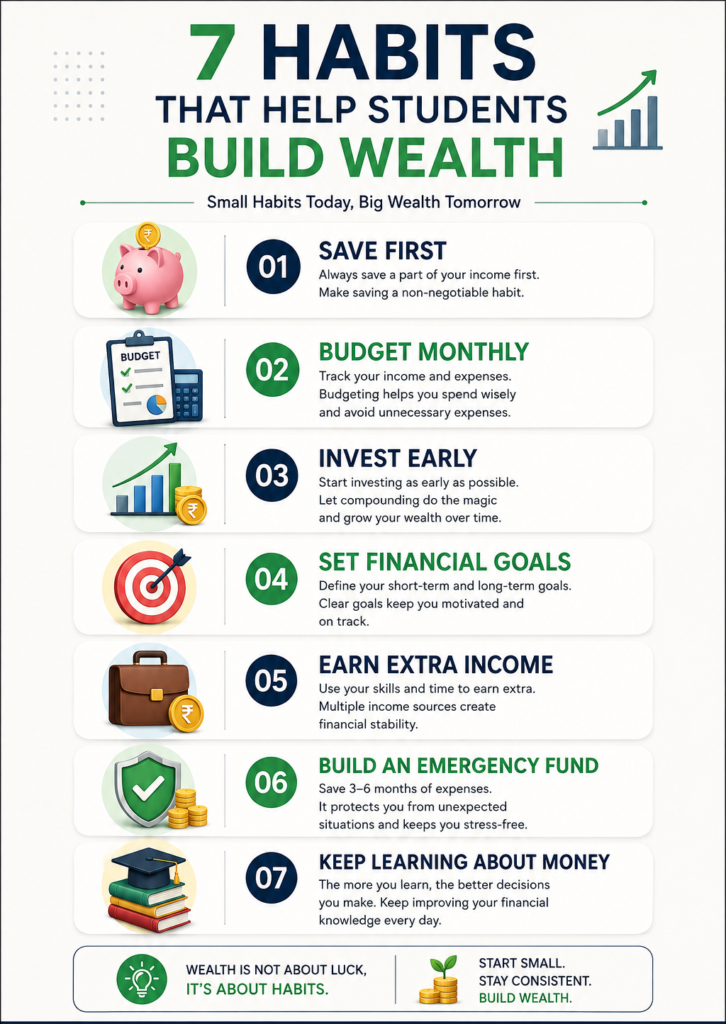
Wealth is usually built through consistent habits rather than one big financial decision.
Habits That Can Help You Build Wealth
- Save before you spend.
- Invest every month.
- Read books about personal finance.
- Track your net worth once a month.
- Learn a new skill every year.
- Avoid comparing yourself with others.
- Set yearly financial goals.
- Continue improving your financial knowledge.
Even spending 15–20 minutes each week learning about money can improve your financial decisions over time. Remember, financial education is an investment that continues to pay dividends throughout your life. You should check 7 money habits to become financially successful.
Common Mistakes Students Should Avoid
Many students delay building wealth because they make avoidable mistakes.
Here are some of the most common ones:
- Waiting for a high-paying job before investing.
- Spending all internship income.
- Depending only on savings instead of investing.
- Following investment tips from social media without research.
- Ignoring budgeting.
- Taking unnecessary loans.
- Not building an emergency fund.
- Trying to get rich quickly through risky investments.
Avoiding these mistakes can put you years ahead financially.

Conclusion
Building wealth in your 20s doesn’t require a large salary or perfect market timing. It starts with simple habits—budgeting, saving regularly, investing wisely, avoiding unnecessary debt, and continuously improving your financial knowledge.
As a student, your greatest financial advantage is time. The decisions you make today can shape your financial future for decades.
Don’t wait for the “perfect” moment to start. Begin with whatever amount you can manage, stay consistent, and let discipline and patience work in your favor.
Remember, wealth is built one smart financial decision at a time.
Frequently Asked Questions (FAQs)
Can a student really build wealth?
Yes. Wealth-building starts with good financial habits. Even small, regular savings and investments can grow significantly over time.
How much should a student invest every month?
There is no fixed amount. Invest what you can comfortably afford after covering your essential expenses. Consistency matters more than investing a large amount.
Is investing risky?
All investments carry some level of risk. Understanding what you invest in, diversifying your portfolio, and focusing on long-term goals can help manage those risks.
Should I save first or invest first?
It’s generally a good idea to first build a small emergency fund. After that, continue saving while investing regularly for your long-term goals.
What is the biggest advantage students have?
Time.
Starting early allows your investments to benefit from compounding for many years.