

Table of Contents
Introduction:
Starting your investment journey can feel confusing when you are young, salaried, or still studying. You may hear people talk about stocks, mutual funds, Demat accounts, SIPs, ETFs, and trading apps, but you may not know where to begin. The good news is that Best SIP Plans for Beginners in India are not about choosing the most popular fund blindly. They are about choosing the right investment category, starting with a comfortable amount, and building discipline for long-term wealth.
SIP is one of the easiest ways to start investing in mutual funds. It helps you invest a fixed amount regularly, even if you begin with ₹500 or ₹1,000 per month. AMFI explains SIP as a convenient method where investors can give standing instructions to debit money regularly, and it also helps with rupee cost averaging and disciplined investing. (AMFI India)
This guide will help you understand how SIP works, which SIP categories are suitable for beginners, how much you should invest, common mistakes to avoid, and how platforms like Angel One and Dhan can help you open an investment account.
What is SIP?
SIP stands for Systematic Investment Plan. It is a method of investing a fixed amount regularly in a mutual fund scheme. SIP is not a separate product. It is only a route to invest in mutual funds.
For example, you can start a SIP of:
- ₹500 per month
- ₹1,000 per month
- ₹5,000 per month
- ₹10,000 per month
Your money gets invested automatically on your selected date. This makes investing easy for students, salaried employees, and beginners who do not want to track the market daily.
Meaning of SIP
A SIP allows you to invest small amounts regularly instead of investing a large amount at once.
For example, instead of investing ₹60,000 in one day, you can invest ₹5,000 every month for 12 months.
This helps you:
- Build investment discipline
- Reduce the fear of market timing
- Start with a small amount
- Stay invested for long-term goals
How SIP Investment Works
When you invest through SIP, your money buys units of a mutual fund.
The price of each unit is called NAV, or Net Asset Value. NAV changes daily based on the market value of the fund’s investments.
If the NAV is low, your SIP buys more units.
If the NAV is high, your SIP buys fewer units.
This is called rupee cost averaging.
SIP Example
Suppose you invest ₹1,000 every month.
| Month | NAV | Units Bought |
|---|---|---|
| January | ₹100 | 10 units |
| February | ₹80 | 12.5 units |
| March | ₹125 | 8 units |
In three months, you invested ₹3,000 and received 30.5 units.
This method helps you invest during both high and low markets. You do not need to guess the perfect day to invest.
Benefits of SIP Investment for Beginners
SIP is popular because it is simple and practical. For most beginners, the biggest challenge is not finding the highest return. The biggest challenge is starting and staying consistent.
Start with Small Amount
You do not need lakhs of rupees to start SIP. Many mutual fund schemes allow SIPs from small amounts. This makes SIP useful for students and young salaried employees.
A student can start with ₹500 per month. A salaried employee can start with ₹1,000 to ₹5,000 per month. The goal is not to become rich in one year. The goal is to build a long-term investing habit.
Power of Compounding
Compounding means your returns can also start earning returns.
For example, if you invest ₹5,000 per month for 20 years and assume a 12% CAGR, your total invested amount will be ₹12 lakh. But your estimated corpus can become much larger because of compounding. Stock market returns are not guaranteed, but for educational examples, we can assume 12% CAGR as a long-term estimate.
The earlier you start, the more time your money gets to grow.
Disciplined Investing
SIP creates automatic discipline. Once your SIP is active, the amount gets invested every month. This reduces the chance of spending that money unnecessarily. For salaried employees, it is better to keep the SIP date close to salary credit date. This helps you invest before you spend.
Lower Risk Compared to Lump Sum
SIP does not remove market risk, but it reduces timing risk. If you invest a large amount in one day, you may worry about whether the market is high or low. SIP spreads your investment across time. This is helpful for beginners who do not understand market cycles.
Flexible and Convenient
SIP is flexible.
You can:
- Start small
- Increase SIP later
- Pause SIP if needed
- Stop SIP if required
- Start multiple SIPs for different goals
But remember, stopping SIP frequently can hurt your long-term wealth creation.
Types of SIP Plans in India
Before choosing the best SIP plans for beginners in India, you should understand the different types of SIP options.
Regular SIP
- This is the most common SIP type.
- You invest a fixed amount every month.
- Example: ₹2,000 per month for 10 years.
- This is ideal for beginners because it is simple and easy to manage.
Step-Up SIP
In a step-up SIP, your SIP amount increases every year.
Example:
| Year | Monthly SIP |
|---|---|
| Year 1 | ₹2,000 |
| Year 2 | ₹2,500 |
| Year 3 | ₹3,000 |
This is useful for salaried employees because income usually increases over time. If your salary grows, your SIP should also grow.
Flexible SIP
In a flexible SIP, you can change the investment amount based on your income or market condition. This may be useful for business owners or freelancers whose monthly income is not fixed. However, beginners should first start with regular SIP before trying flexible SIP.
Perpetual SIP
A perpetual SIP does not have a fixed end date. It continues until you stop it. This is useful for long-term wealth creation, but you should still review your investments once or twice a year.
Trigger SIP
Trigger SIP works based on market triggers or specific conditions. For example, extra investment may happen when the market falls by a certain percentage. This is more advanced and not necessary for most beginners.
Best SIP Plans for Beginners in India
The phrase “best SIP plan” can be misleading. There is no single best SIP for everyone.
The right SIP depends on:
- Your age
- Your income
- Your risk capacity
- Your investment goal
- Your time horizon
- Your financial responsibilities
SEBI’s investor guidance also highlights that investors should understand their risk profile, income, cash flow, and ability to handle financial risk before investing in funds. (Securities and Exchange Board of India)
Instead of chasing the highest past return, beginners should choose suitable mutual fund categories.
Index Fund SIPs
Index funds are one of the best starting points for beginners. They track an index like Nifty 50 or Sensex. The fund manager does not try to beat the market. The fund simply follows the index.
Index funds are suitable because they are:
- Simple
- Low-cost
- Easy to understand
- Diversified
- Suitable for long-term investing
A beginner who wants to build wealth over 10 to 20 years can consider starting with an index fund SIP.
Large Cap Fund SIPs
Large cap funds invest mainly in big and established companies.
These companies usually have stronger business history and better stability compared to smaller companies.
Large cap SIPs may be suitable for beginners who want equity exposure but do not want very high volatility.
However, large cap funds are still market-linked. Returns are not guaranteed.
Hybrid Fund SIPs
Hybrid funds invest in both equity and debt.
Equity gives growth potential. Debt adds stability.
This can be useful for beginners who are afraid of full equity risk.
For example, if you want moderate risk, you may consider a hybrid fund instead of a pure equity fund.
ELSS SIPs
ELSS stands for Equity Linked Savings Scheme.
It is a tax-saving mutual fund category. ELSS may help investors claim deduction under Section 80C, subject to the allowed limit and tax regime rules.
ELSS comes with a three-year lock-in period.
This means you cannot withdraw your investment before three years. If you invest through SIP, each SIP instalment has its own three-year lock-in.
ELSS can be useful for salaried employees who follow the old tax regime and need tax-saving options.
Suggested Beginner SIP Categories
| Investor Type | Suitable SIP Category | Risk Level | Ideal Time Horizon |
|---|---|---|---|
| Student | Index Fund | Moderate to High | 7+ years |
| New Salaried Employee | Index Fund / Large Cap Fund | Moderate to High | 7+ years |
| Conservative Beginner | Hybrid Fund | Moderate | 3–5+ years |
| Tax-Saving Investor | ELSS Fund | High | 3+ years |
| Long-Term Wealth Builder | Index / Flexi Cap Fund | High | 10+ years |
[Internal Link: See our guide on how to start investing with ₹500]
Best SIP Amount to Start With
The best SIP amount is not the highest amount. It is the amount you can continue comfortably.
Many beginners start with too much excitement and stop after a few months. This is not the right approach.
Start small, stay consistent, and increase gradually.
SIP with ₹500
A ₹500 SIP is suitable for students and first-time investors.
It helps you understand:
- How mutual funds work
- How NAV changes
- How market volatility feels
- How to build investing discipline
A ₹500 SIP will not make you rich quickly, but it can build a strong habit.
SIP with ₹1,000–₹5,000
This range is suitable for beginners who have a regular income.
For example:
- ₹1,000 SIP for low-income beginners
- ₹2,000 SIP for students with side income
- ₹5,000 SIP for salaried employees
If your income is ₹30,000 per month, you can start with ₹3,000 to ₹5,000 if your expenses are under control.
How to Decide Your SIP Amount
Use this simple formula:
Monthly SIP = Income – Expenses – Emergency Saving – Short-Term Goals
Do not invest money that you need for rent, food, fees, EMIs, or family responsibilities.
A good beginner approach:
- First build an emergency fund
- Then start SIP
- Then increase SIP every year
[Internal Link: See our guide on emergency fund planning]
SIP vs FD vs RD
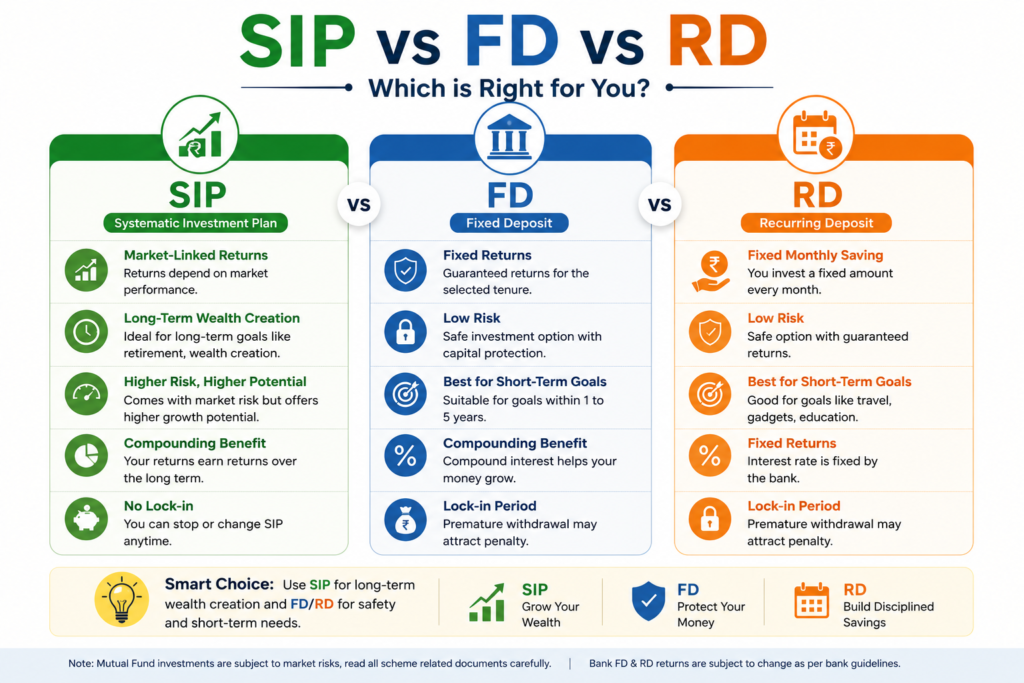
Beginners often ask whether SIP is better than FD or RD.
The answer depends on your goal.
FD and RD are safer than equity mutual funds, but their returns are usually lower. SIP in equity mutual funds has higher growth potential, but it also carries market risk.
SIP vs Fixed Deposit
A fixed deposit gives fixed interest for a fixed period.
It is useful for:
- Emergency money
- Short-term goals
- Low-risk investors
- Capital protection
SIP in equity funds is useful for:
- Long-term wealth creation
- Retirement planning
- Beating inflation
- Financial independence
SIP vs Recurring Deposit
RD is a monthly saving product where you deposit a fixed amount and earn fixed interest.
It is useful for short-term goals like buying a phone, paying fees, or planning a small trip.
SIP is better suited for long-term goals where you can accept market risk.
Which is Better for Long-Term Wealth?
| Feature | SIP in Mutual Funds | Fixed Deposit | Recurring Deposit |
|---|---|---|---|
| Returns | Market-linked | Fixed | Fixed |
| Risk | Moderate to High | Low | Low |
| Best For | Long-term wealth | Safety | Short-term saving |
| Liquidity | Depends on fund | Depends on bank terms | Depends on bank terms |
| Inflation Protection | Better potential | Limited | Limited |
| Return Guarantee | No | Yes | Yes |
For long-term goals, SIP can be better.
For short-term safety, FD or RD can be better.
How to Start SIP in India Step-by-Step

Starting SIP in India is simple, but beginners should follow the right process.
Choose Financial Goal
Do not start SIP randomly.
First decide your goal:
- Wealth creation
- Retirement
- Higher education
- Buying a house
- Tax saving
- Financial freedom
A clear goal helps you choose the right fund category.
Select Mutual Fund Platform
You can start SIP through:
- AMC website
- Mutual fund app
- Bank platform
- Broker platform
- Investment platform
For general investing, stocks, ETFs, and mutual funds, you may open an account with platforms like Angel One or Dhan.
Angel One publishes its brokerage and transaction charges on its official website. Its brokerage structure may include ₹0 brokerage up to a specified limit for the first 30 days and then lower of ₹20 or 0.1% per executed order for certain segments, subject to terms and changes. (Angel One)
Dhan states that users can invest in direct mutual funds at zero cost on its mutual fund platform, and its pricing page mentions free account opening, zero AMC or platform fees, and free equity delivery, ETFs, IPOs, and mutual funds, subject to current terms. (Dhan)
Important: You do not always need a Demat account only for mutual fund SIPs. Mutual fund investments can also be held in statement-of-account format. But a Demat and trading account can be useful if you also want to invest in stocks, ETFs, IPOs, and other market products.
1. Open Demat Account with Angel One
2. Open Demat Account with Dhan
Complete KYC
To invest in mutual funds, you need KYC.
Usually, you need:
- PAN card
- Aadhaar
- Bank account
- Mobile number
- Email ID
- Basic personal details
Without KYC, you cannot start mutual fund investments properly.
Select SIP Amount and Date
Choose an SIP date near your salary date.
For example, if your salary comes on the 1st, you can keep your SIP date between the 3rd and 7th.
This helps avoid failed payments.
Start Auto-Debit
After selecting the fund and amount, set up auto-debit. Your SIP amount will be deducted automatically every month. This helps you invest regularly without manual effort.
Mistakes Beginners Should Avoid
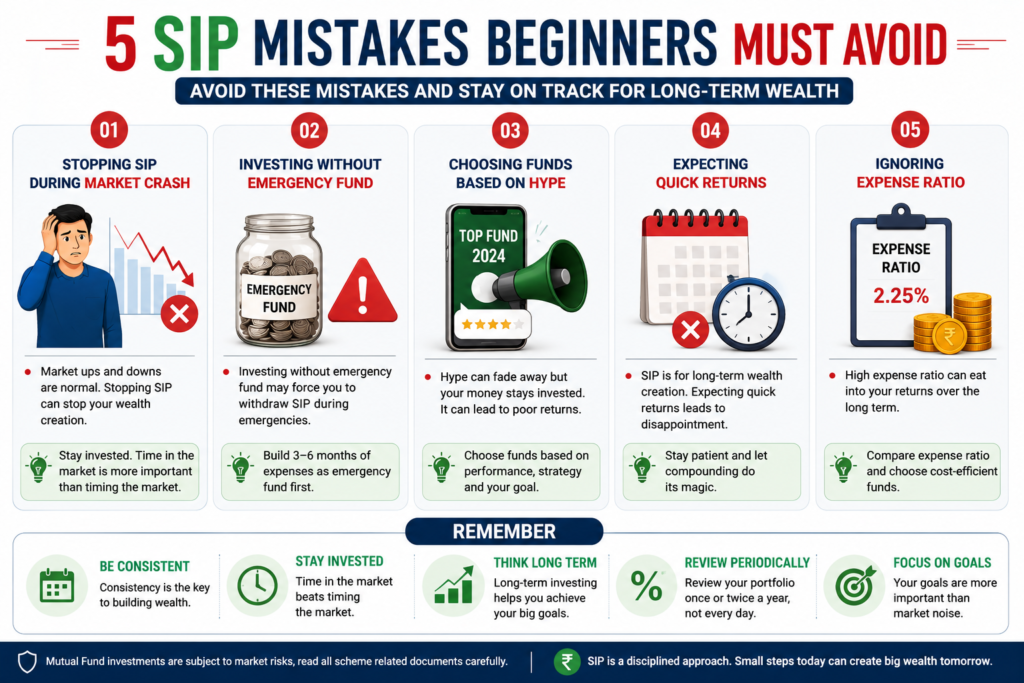
SIP is simple, but many beginners make avoidable mistakes.
Stopping SIP During Market Crash
Market falls are normal.
Many beginners panic and stop SIP when markets fall. But during market falls, SIP buys more units.
If your goal is long-term, market corrections can help you accumulate more units.
Investing Without Emergency Fund
Do not invest all your money in SIP.
First build an emergency fund of at least 3 to 6 months of basic expenses.
This emergency fund protects you during job loss, medical needs, or family emergencies.
See our complete guide on emergency fund.
Choosing Funds Based on Hype
Do not choose a fund because someone on YouTube, Instagram, or Telegram said it is the best.
Check:
- Fund category
- Risk level
- Expense ratio
- Fund history
- Portfolio
- Investment objective
- Consistency
Expecting Quick Returns
SIP is not for quick money.
If you invest for only 6 months or 1 year, returns may be negative.
Equity SIPs need patience. Ideally, invest for at least 5 to 7 years or more.
Ignoring Expense Ratio
Expense ratio is the annual cost charged by the fund house.
A lower expense ratio can improve long-term returns, especially in index funds.
But do not select a fund only because it has the lowest cost. Also check tracking error, fund size, and consistency.
How Much Can SIP Grow Over Time?

Let us assume a long-term CAGR of 12% for educational understanding.
Actual returns can be higher or lower. Mutual funds are market-linked and do not give guaranteed returns.
10-Year SIP Example
If you invest ₹5,000 per month for 10 years:
| Details | Amount |
|---|---|
| Monthly SIP | ₹5,000 |
| Time Period | 10 years |
| Total Invested | ₹6,00,000 |
| Assumed CAGR | 12% |
| Estimated Value | Around ₹11.5 lakh |
This shows how compounding can help your money grow.
20-Year Wealth Projection
If you invest ₹5,000 per month for 20 years:
| Details | Amount |
|---|---|
| Monthly SIP | ₹5,000 |
| Time Period | 20 years |
| Total Invested | ₹12,00,000 |
| Assumed CAGR | 12% |
| Estimated Value | Around ₹50 lakh |
This is why starting early matters.
A small SIP can become powerful when you give it enough time.
Importance of Staying Invested Long-Term
The market will not move in a straight line.
Some years will be good.
Some years will be bad.
Some years will test your patience.
Long-term investors focus on goals, not daily market noise.
Is SIP Safe for Beginners?
SIP is a disciplined investment method, but it is not risk-free.
Mutual funds are subject to market risks. Your investment value can go up or down.
SEBI’s investor charter focuses on investor awareness, transparency, rights, responsibilities, and grievance redressal in the securities market.
Understanding Market Risks
Different funds have different risk levels.
- Liquid funds: Lower risk
- Debt funds: Low to moderate risk
- Hybrid funds: Moderate risk
- Large cap funds: Moderate to high risk
- Mid cap funds: High risk
- Small cap funds: Very high risk
- Sector funds: Very high risk
Beginners should not start with high-risk funds just because past returns look attractive.
How Diversification Helps
Diversification means spreading your investment across many companies or assets.
A mutual fund already gives diversification because it invests in many securities.
This reduces the risk of depending on one company.
Why SIP is Safer Than Timing the Market
Market timing means trying to invest at the lowest point and sell at the highest point.
Most beginners cannot do this successfully.
SIP removes this pressure. You invest regularly and let time work for you.
Conclusion
SIP is one of the simplest ways for beginners in India to start investing. It allows students and salaried employees to begin with small amounts and build long-term wealth with discipline.
But the best SIP plans for beginners in India are not about chasing the highest-return fund. The right approach is to understand your goal, choose a suitable fund category, invest regularly, and stay patient.
If you are new, start with a simple category like an index fund, large cap fund, or hybrid fund. Build an emergency fund first, avoid hype, and review your investments once or twice a year.
You can also open an investment account with platforms like Angel One or Dhan if you want to invest in mutual funds, stocks, ETFs, and IPOs from one place. Add your referral links clearly with proper disclosure.
Start small. Stay consistent. Increase your SIP as your income grows.
That is how beginners become confident long-term investors.
Disclaimer: This article is for educational purposes only and should not be treated as investment advice. Mutual fund investments are subject to market risks. Please read all scheme-related documents carefully and consult a qualified financial advisor before investing.
FAQs About SIP Investment
Can I start SIP with ₹500?
Yes, many mutual fund schemes allow small SIP amounts. A ₹500 SIP is a good starting point for students and first-time investors. The main benefit is habit formation. Once your income grows, you can increase the SIP amount.
Which SIP is best for beginners?
For most beginners, index funds, large cap funds, and hybrid funds can be good starting categories. The best SIP depends on your goal, risk profile, and investment period. Do not select a fund only by looking at last year’s return.
Is SIP better than FD?
SIP and FD serve different purposes. FD is better for safety and short-term goals. SIP in equity mutual funds can be better for long-term wealth creation, but it carries market risk. A smart investor can use both.
Can SIP make me rich?
SIP can help you build wealth over time, but it is not a quick-rich method.
You need:
- Long-term discipline
- Right fund selection
- Regular investment
- Patience during market falls
- Annual review
What happens if I miss one SIP payment?
Usually, missing one SIP payment does not create a major issue. But repeated failures may stop your SIP mandate or create bank-related charges. Keep enough balance before your SIP date.
Can students invest in SIP?
Yes, students above 18 years can invest in SIP after completing KYC. Students can start small with ₹500 or ₹1,000 per month. The purpose should be learning and habit-building. You can use your parent’s data by their permission.
Do I need a Demat account for SIP?
Not always.
Mutual funds can be held without a Demat account through AMC or mutual fund platforms. But a Demat and trading account is useful if you want to invest in stocks, ETFs, IPOs, and other market products.
Should I choose Angel One or Dhan for investing?
Both are popular platforms. Angel One offers investing and trading services across multiple segments. Dhan also offers stocks, ETFs, IPOs, mutual funds, and trading tools.
Before opening an account, compare:
- Brokerage
- AMC
- Platform fees
- DP charges
- App experience
- Customer support
- Your investing needs
- Charges and terms can change, so always check the latest official pricing before opening an account.