

Table of Contents
Introduction
How to Start Investing with ₹500 Per Month in India?
Many beginners believe investing is only for people with a high salary, strong financial knowledge, or lakhs of rupees sitting in their bank account. This is not true.
You can start investing with ₹500 per month in India and still build a powerful financial habit. The amount may look small today, but the habit of investing regularly can become one of the most valuable habits of your life.
For students and salaried beginners, ₹500 is a practical starting point. It is not too heavy on the pocket, and it helps you learn how investing works without taking a very large risk.
The goal is simple: start small, stay consistent, and allow time to work in your favour.
Investing is not about becoming rich overnight. It is about building discipline, understanding money, and making better financial decisions over time.
👉🏻 See our beginner guide on personal finance basics

Why Starting with ₹500 Per Month Is Still Powerful:
Starting with ₹500 may not look exciting, but it can create a strong foundation. Most people do not fail because they invest a small amount. They fail because they never start.
A small monthly investment teaches you how to manage money, control unnecessary spending, and think about your future.
For a beginner, the first step is not to chase high returns. The first step is to become comfortable with the habit of investing.
Small Investments Build Big Financial Discipline:
Financial discipline does not come from earning a huge income. It comes from making consistent decisions with the money you already have.
When you invest ₹500 every month, you train yourself to pay your future first before spending on unnecessary things.
This habit can help you:
- Avoid careless spending
- Build long-term thinking
- Understand the value of consistency
- Become more confident with money
- Create a routine of saving and investing
For students, ₹500 may come from pocket money, part-time income, or small savings. For salaried employees, it may come from reducing one or two unnecessary expenses.
The amount is small, but the mindset is powerful. A person who learns to invest ₹500 today can later manage ₹5,000, ₹10,000, or even ₹50,000 per month with more confidence.
Time Matters More Than the Starting Amount:
In investing, time is often more powerful than the starting amount. A beginner who starts early with ₹500 per month may build better financial habits than someone who waits for years to start with a bigger amount.
This is because of compounding. Compounding means your money can earn returns, and those returns may also start earning returns over time. The longer you stay invested, the more time your money gets to grow.
For example, if you invest regularly for 10, 15, or 20 years, the long-term result can become meaningful because time supports your investment journey. But remember, market-linked investments do not give guaranteed returns. Returns can go up and down in the short term. That is why patience is important.
The purpose of starting with ₹500 is not to become wealthy immediately. The purpose is to give yourself more time to learn, grow, and stay consistent.
The Goal Is to Start, Not to Be Perfect:
Many beginners delay investing because they want to find the “perfect” investment option.
They keep asking:
- Which fund is best?
- Which app should I use?
- What if the market falls?
- What if I lose money?
- Should I wait for the right time?
These questions are natural, but waiting for perfection can stop your progress. The better approach is to start carefully with a small amount, understand the basics, and improve your decisions slowly. You do not need to know everything on day one. You only need to know enough to begin safely.
Before investing, learn the basic difference between safe saving options and market-linked investments. Understand that every investment has some level of risk. Also, never invest money that you need for rent, fees, food, bills, or emergency expenses.
Starting with ₹500 per month keeps the pressure low. It allows you to learn without feeling afraid of every market movement.
The real goal is not perfection. The real goal is progress with discipline.
Can You Really Start Investing with ₹500 in India?
Yes, you can start investing with ₹500 per month in India. Many beginners think investing needs thousands of rupees, but that is not true anymore.
Today, several mutual fund SIPs, digital investment platforms, and banking products allow small monthly investments. For students and salaried beginners, ₹500 is enough to start learning how money grows over time.
The main benefit is not only returns. The bigger benefit is building the habit of investing regularly.
Yes, Many SIPs Start from ₹500:
A SIP, or Systematic Investment Plan, allows you to invest a fixed amount in a mutual fund every month. Many mutual funds allow SIPs starting from ₹500 per month.
This makes SIPs beginner-friendly because you do not need a large amount at once. You can start small and increase your SIP later when your income improves.
However, SIPs are market-linked. This means returns are not guaranteed. Your investment value can go up or down depending on market performance.
Some Platforms Also Allow Small Investments:
Many investment platforms in India allow users to start with small amounts. You can explore mutual funds, stocks, ETFs, and other investment options through trusted platforms.
If you are planning to open a Demat account, platforms like Angel One and Dhan can be explored. They provide access to stock market investing, mutual funds, ETFs, and basic investment tools. And you can open your demat account for free.
Before opening any account, compare:
- Account opening charges
- Brokerage charges
- Platform features
- Customer support
- Ease of use
- Suitability for beginners
You can add your referral links naturally here:
Open Demat Account with Angel One
Open Demat Account with Dhan
Always read the latest charges and terms before opening an account.
What Should You Do Before Investing?
Before investing, check your basic financial condition. Investing is important, but it should not disturb your daily needs or emergency safety.
Clear Your Basic Monthly Expenses:
First, make sure your important expenses are covered. These include food, rent, education fees, transport, mobile recharge, family support, and bills.
Do not invest money that you need for essential expenses. Investing should support your life, not create stress.
Create a Small Emergency Fund First:
Before taking market risk, try to build a small emergency fund. This can be money kept in a savings account for urgent needs.
For students, even ₹2,000–₹5,000 can be a useful start. For salaried employees, aim slowly for at least 3–6 months of basic expenses.
Avoid Investing Borrowed Money:
Never invest using borrowed money, credit card funds, or personal loans.
Market investments can fall in the short term. If you invest borrowed money and the market goes down, you may face both loss and debt pressure.
Invest only from your own surplus money.
Understand Your Risk Level:
Every beginner has a different risk level. A student, a salaried employee, and a business owner may not have the same financial stability.
Ask yourself:
- Can I stay invested for 5 years or more?
- Will I panic if my investment falls?
- Do I need this money soon?
- Do I understand the product?
If your risk level is low, start with safer options. If your goal is long-term wealth building, market-linked options may be considered carefully.
Best Investment Options for ₹500 Per Month in India:
Here are some beginner-friendly options for small monthly investing.
Mutual Fund SIPs:
Mutual fund SIPs are one of the most popular ways to start investing with ₹500 per month.
Why SIPs Are Good for Beginners:
SIPs help you invest regularly without timing the market. They are useful for long-term goals like wealth building, education planning, or future financial independence.
Risks of Mutual Fund SIPs:
SIPs are not risk-free. Returns depend on market performance. Equity funds can fall in the short term, so beginners should stay patient and invest for the long term.
Index Funds:
Index funds invest in a market index like Nifty 50 or Sensex.
Why Index Funds Are Simple and Low-Cost:
Index funds are simple because they follow the market instead of trying to beat it. They usually have lower costs than many actively managed funds.
Who Should Consider Index Funds?
Beginners who want a simple, long-term, low-cost investment option may consider index funds after understanding risk.
Recurring Deposit:
A Recurring Deposit, or RD, is offered by banks and post offices.
Why RD Is Safer Than Market Investments:
RDs are not linked to stock market movements. They offer fixed returns, making them suitable for short-term goals and low-risk investors.
Limitations of Recurring Deposits:
RD returns are usually lower than long-term equity investments. Also, returns may not always beat inflation after tax.
Public Provident Fund:
PPF is a government-backed long-term saving scheme.
Why PPF Is Useful for Long-Term Saving:
PPF offers safety, tax benefits, and long-term disciplined saving. It can be useful for conservative investors.
Why PPF May Not Be Ideal for Short-Term Goals:
PPF has a long lock-in period of 15 years. So, it is not suitable if you need money in the next few months or years.
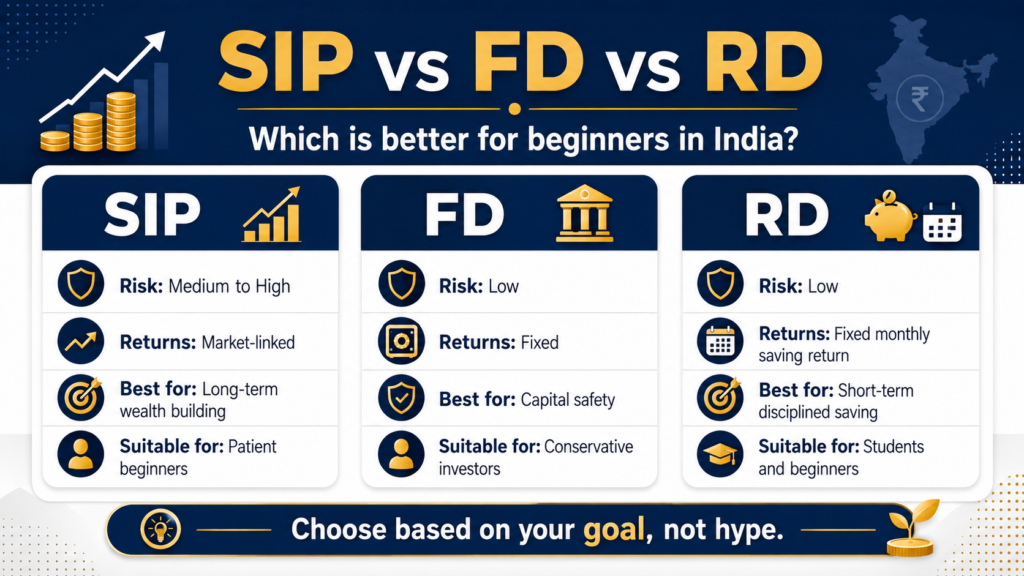
SIP vs FD vs RD: Which Is Better for Beginners?
Choosing between SIP, FD, and RD depends on your goal, time period, and risk comfort. Do not choose any option only because someone says it gives “high returns.”
| Option | Risk Level | Return Type | Best For | Beginner Suitability |
|---|---|---|---|---|
| SIP | Medium to High | Market-linked | Long-term wealth building | Good for patient beginners |
| FD | Low | Fixed return | Capital safety | Good for conservative investors |
| RD | Low | Fixed monthly saving return | Short-term disciplined saving | Good for students and beginners |
SIP for Long-Term Wealth Building:
A SIP is suitable when your goal is long-term wealth creation. If you can stay invested for 5 years or more, equity mutual fund SIPs or index fund SIPs may help your money grow better than traditional saving options.
But SIP returns are not guaranteed. Markets can rise and fall. So, invest only if you can stay patient.
FD and RD for Safety and Stability:
FDs and RDs are better when safety is your first priority. They give fixed returns and are not directly affected by stock market ups and downs.
For short-term goals like saving for exam fees, laptop purchase, or emergency backup, RD or FD may be more suitable than SIP.
Choose Based on Your Goal, Not Hype:
If your goal is safety, FD or RD may be better.
If your goal is long-term growth, SIP may be better.
The right choice is not the most popular option. The right choice is the one that matches your financial goal.
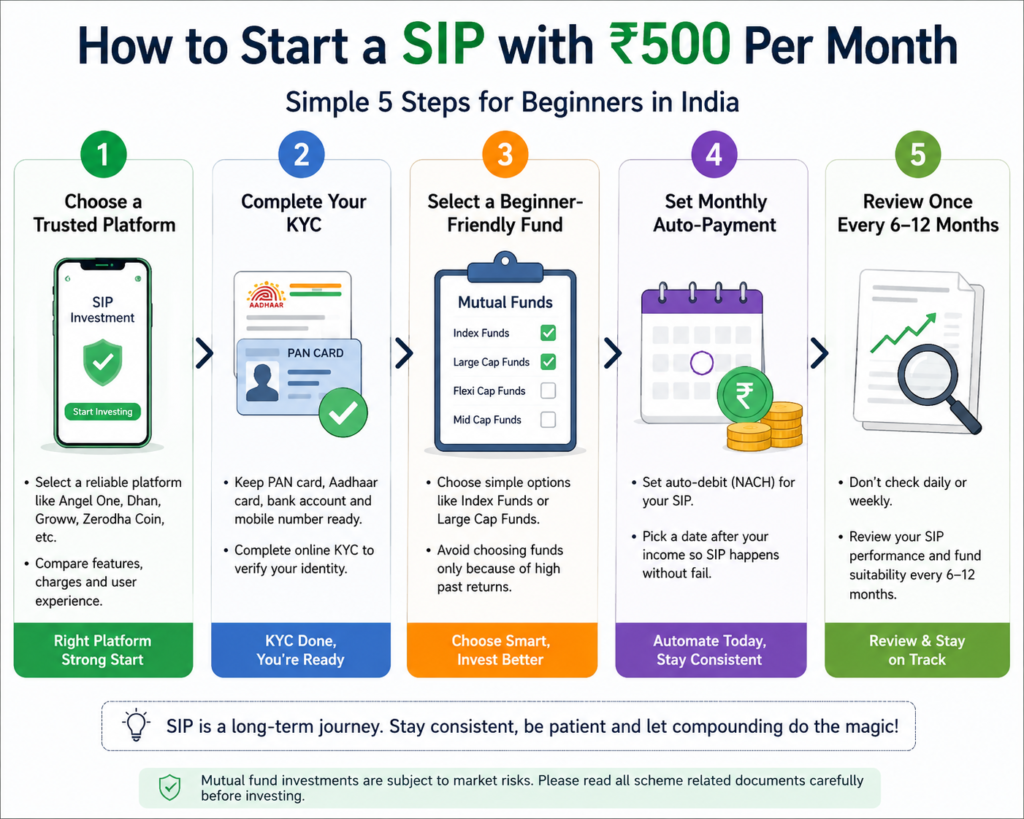
How to Start a SIP with ₹500 Per Month:
Step 1: Choose a Trusted Investment Platform
Choose a platform that is simple, transparent, and beginner-friendly. You can explore platforms like Angel One and Dhan for Demat account opening, mutual funds, ETFs, and basic investment tools.
Before opening an account, check brokerage, charges, features, and customer support.
Open Demat Account with Angel One
Open Demat Account with Dhan
Step 2: Complete Your KYC
KYC means Know Your Customer. You usually need your PAN card, Aadhaar, bank account, and mobile number.
Without KYC, you cannot start investing in mutual funds or stock market products.
Step 3: Select a Beginner-Friendly Fund
Beginners can consider simple options like index funds or large-cap mutual funds after understanding the risks.
Avoid choosing funds only because they gave high returns last year.
Step 4: Set Monthly Auto-Payment
Set an auto-payment date after your salary, pocket money, or monthly income arrives. This helps you invest regularly without forgetting.
Step 5: Review Once Every 6–12 Months
Do not check your portfolio every day. Review your SIP once every 6–12 months to see whether it still matches your goal.
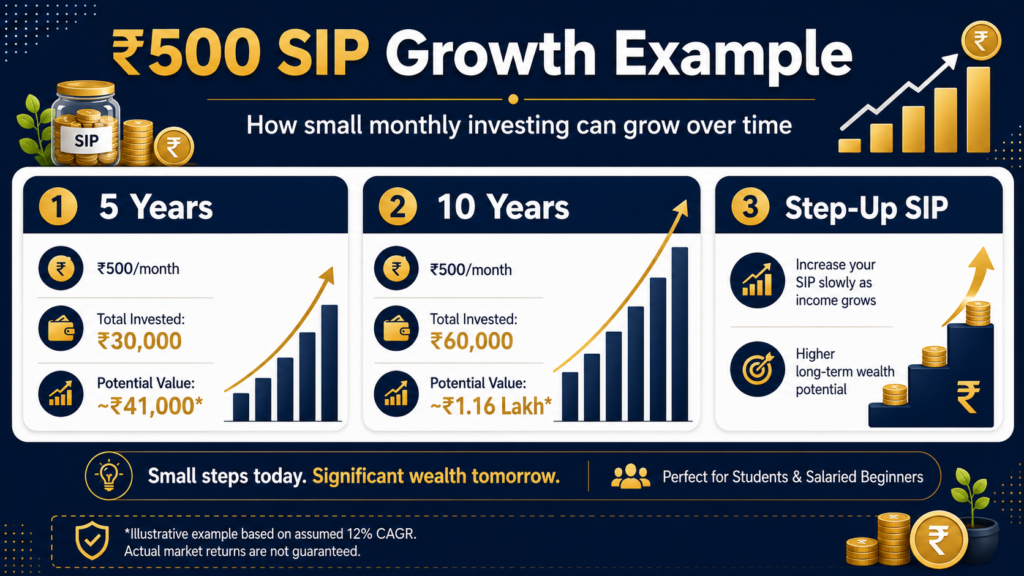
Example: How ₹500 Per Month Can Grow Over Time
Assuming a 12% CAGR, your investment may grow like this. This is only an example. Market returns are not guaranteed.
If You Invest ₹500 Monthly for 5 Years
You invest ₹30,000 in total. At 12% CAGR, it may grow to around ₹41,000.
If You Invest ₹500 Monthly for 10 Years
You invest ₹60,000 in total. At 12% CAGR, it may grow to around ₹1.16 lakh.
If You Increase Your SIP Slowly Over Time
If you start with ₹500 and increase it as your income grows, your long-term result can become much stronger. This is called a step-up SIP.
Common Mistakes Beginners Should Avoid:
Beginners do not lose money only because of bad investments. Many times, they lose confidence because of wrong habits.
Chasing High Returns Quickly
Do not invest only because someone promises “double money” or very high returns. Genuine investing takes time. Fast-return thinking can lead to risky decisions.
Stopping SIPs During Market Falls
Market falls are normal. If your goal is long-term, stopping SIPs during every fall can hurt your wealth-building journey. Continue only if your fund and goal are still suitable.
Investing Without Understanding Risk
Before investing, understand whether the product is safe, market-linked, locked-in, or taxable. Never invest just because an app shows it as “popular.”
Copying Influencers Blindly
Financial influencers may share useful ideas, but your money decision should depend on your income, goals, risk level, and time period.
Checking Portfolio Every Day
Daily checking creates stress. For beginners, reviewing once every 6–12 months is enough.
Simple Investment Plan for Students and Beginners:
Start with ₹500 Per Month
Begin with an amount that does not disturb your basic expenses. ₹500 is enough to build the habit.
Increase SIP When Income Increases
When your salary, pocket money, or business income grows, increase your SIP slowly. Even a small yearly increase can make a big difference over time.
Keep Learning Personal Finance
Learn about SIPs, emergency funds, insurance, taxation, and risk. Better knowledge helps you avoid costly mistakes.
Stay Consistent for the Long Term
Consistency is more important than excitement. A calm investor usually makes better decisions than an emotional investor.
Final Thoughts: Start Small, Stay Patient, Build Wealth Slowly:
₹500 per month may look small today, but it can start a powerful financial journey. The real value is not only the money you invest. The real value is the habit you build.
Start only after covering your basic needs and emergency safety. Choose simple options, understand the risk, and avoid shortcuts.
A beginner who starts early, stays patient, and keeps learning can build strong financial confidence over time.
Frequently Asked Questions:
Can I start investing with ₹500 in India?
Yes. Many mutual fund SIPs and small investment options allow beginners to start with ₹500 per month.
Is SIP safe for beginners?
SIP is beginner-friendly, but not completely risk-free. Mutual fund SIPs are market-linked, so returns can go up or down.
Which is better for beginners, SIP or FD?
For long-term growth, SIP may be better. For safety and short-term goals, FD may be better.
Can students start investing in mutual funds?
Yes, students above 18 years can invest after completing KYC. They should invest only surplus money.
How much should a beginner invest every month?
A beginner can start with ₹500–₹1,000 per month and increase slowly as income grows.
What is the best investment option for ₹500 per month?
For long-term goals, SIPs or index funds may be suitable. For safety, RD may be better. The best option depends on your goal and risk level.